HR Software · · 19 min read
Best HRIS Systems for Small Businesses in 2026: Top 8 Compared
The 8 best HRIS systems for small businesses in 2026 — ranked, compared, and tested. Includes a free 14-day Plintio trial with no credit card.
By Plintio Team · Last updated
If you're searching specifically for an HRIS — not just "HR software" — you already know what you want: a single system of record for employee data that powers everything else (payroll, benefits, time tracking, performance). The question isn't whether you need one. It's which one fits a small business that doesn't have a dedicated HR specialist or a six-figure implementation budget.
We tested the 8 HRIS platforms most worth considering for small businesses in 2026. The criteria were specific to HRIS use cases: how cleanly does the platform serve as a single source of truth for employee data, how well do integrations push data downstream into payroll and benefits, how strong are audit trails and access controls, and how much engineering work is required to operate it.
This isn't a generic HR software roundup. It's eight HRIS platforms ranked, compared, and honestly reviewed for businesses with 5 to 200 employees.
On this page
- TL;DR: The Best HRIS Systems for Small Businesses
- What is an HRIS, Specifically?
- Why Small Businesses Need a Real HRIS
- How We Evaluated These Platforms
- The 8 Best HRIS Systems for Small Businesses
- Side-by-Side Comparison
- How to Choose the Right HRIS
- Common Mistakes Small Businesses Make
- Frequently Asked Questions
- Final Verdict: The Right HRIS for Most Small Businesses
TL;DR: The Best HRIS Systems for Small Businesses
| Rank | Platform | Best For | Free Trial |
|---|---|---|---|
| 1 ⭐ | Plintio | Small businesses (5-100 employees) wanting a modern HRIS without enterprise pricing | 14 days, no credit card |
| 2 | BambooHR | Established SMBs ready to invest in the most recognized brand | 7 days |
| 3 | Rippling | Tech-forward teams needing HRIS plus IT and device management in one source of truth | Demo only |
| 4 | Gusto | US payroll-first operations wanting HRIS bundled with payroll | Demo only |
| 5 | Paycom | Small businesses planning rapid headcount growth into mid-market | Demo only |
| 6 | ADP Workforce Now | Established US small businesses wanting deep payroll compliance | Demo only |
| 7 | Zoho People | Budget-conscious teams already in the Zoho ecosystem | 15 days |
| 8 | HiBob | Scaleups crossing 100 employees who want a modern mid-market HRIS | Demo only |
Top pick for most small businesses: Plintio is a modern HRIS that gives you the core capabilities of platforms like BambooHR or Rippling — central employee database, role-based access, audit logs, self-service, and clean integrations — at SMB pricing and without a 2-week implementation. Start your free 14-day trial →
What is an HRIS, Specifically?
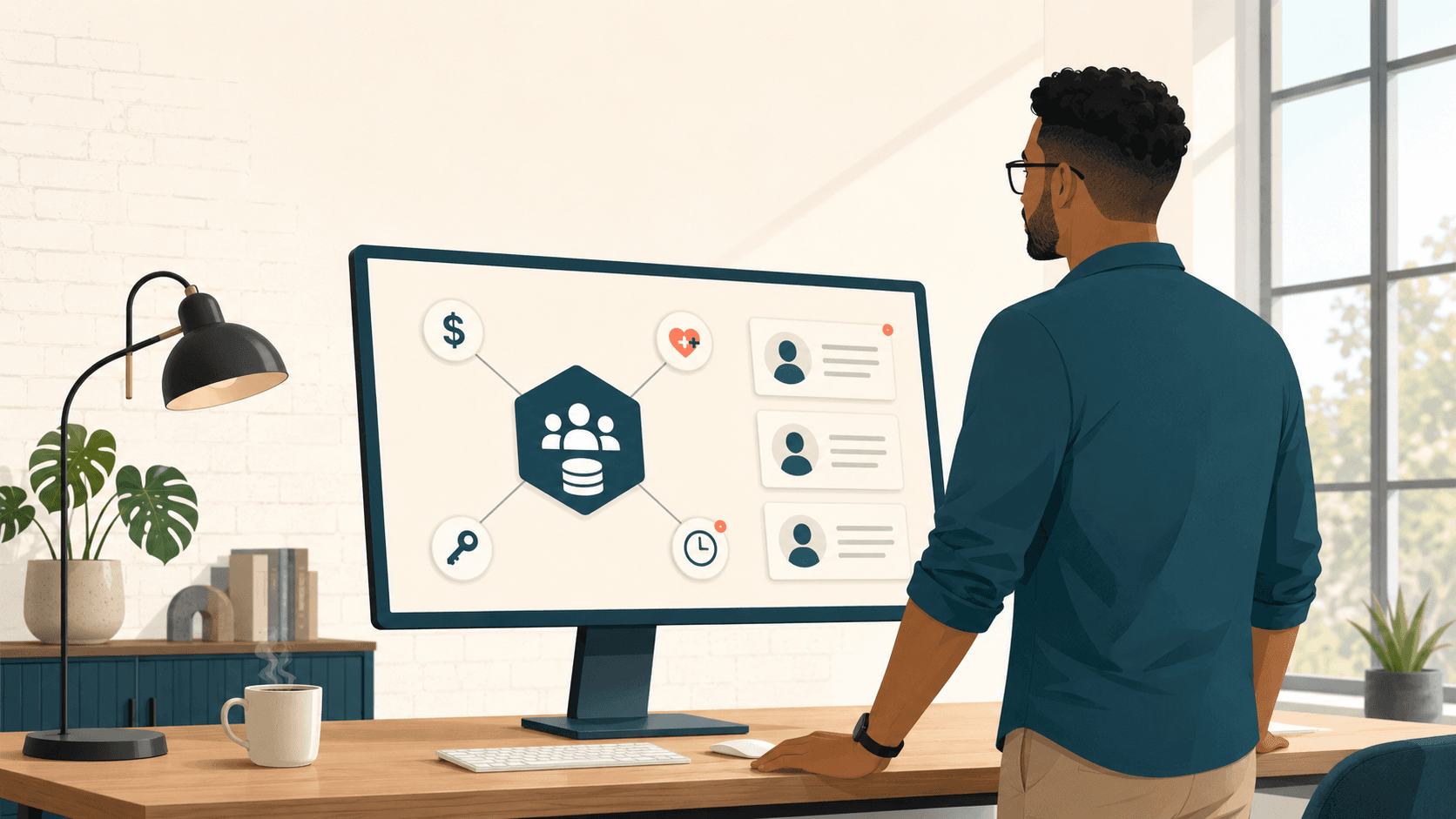
The core capabilities every modern HRIS should provide in 2026:
- Central employee database with custom fields, role hierarchy, and full historical records
- Role-based access controls so managers see their teams, HR sees company-wide, and other functions see only what they need
- Full audit log of every data access, change, and export
- Self-service for employees to view and update their own information
- Document storage with versioning and e-signature for offer letters, NDAs, and policies
- Time-off tracking with manager approval workflows
- Native or bidirectional integrations with payroll, benefits, identity providers (Okta, Google Workspace), and major collaboration tools
- Data export and portability in standard formats (CSV, JSON)
- Reporting on headcount, turnover, and compliance metrics
The difference between an HRIS and a payroll-first platform with HR features is the architectural starting point. An HRIS treats employee data as the primary entity and payroll, benefits, and performance as systems that consume that data. A payroll-first platform treats payroll as the primary entity and HR features as bolted-on additions. Both models can work for small businesses — but the data architecture has long-term implications for reporting, integrations, and compliance.
Why Small Businesses Need a Real HRIS
For the first 5-10 employees, most small businesses can run on spreadsheets and email. Past that, the patchwork starts costing more than the software would. Here's what running without a real HRIS actually costs:
1. Data fragmentation creates compounding errors. When employee data lives in payroll, in a spreadsheet, in a benefits portal, and in a Google Doc somewhere, every update has to happen four times. People skip steps. Information drifts. By the time you notice — usually during open enrollment or an audit — fixing it takes weeks.
2. Compliance gaps hide in plain sight. Modern HRIS platforms keep automatic audit trails of who accessed what data when. Without that, proving compliance during a wage-and-hour dispute, an unemployment claim, or an audit requires reconstructing history from email threads. It's slow, expensive, and often incomplete.
3. Access creep happens silently. When employee data lives in shared cloud folders, every contractor, intern, and ex-employee who ever needed temporary access still has it unless someone manually removed them. A real HRIS handles this with role-based access and automatic offboarding workflows that revoke permissions at the moment of termination.
4. Reporting becomes impossible. Headcount by department, turnover trends, time-to-productivity for new hires, PTO usage patterns — these reports require clean data in a single place. Without an HRIS, every report is a manual spreadsheet exercise that nobody actually does.
5. Manager and owner time gets reclaimed. Without self-service, every PTO request, address change, pay-stub download, and policy acknowledgment requires an admin to handle it manually. A real HRIS pushes these tasks to employees themselves — saving 6-10 hours per week of administrative work for the owner or office manager.
How We Evaluated These Platforms
We rated each HRIS against six criteria specifically relevant to small business use cases:
| Criterion | Why It Matters for an HRIS Specifically | Weight |
|---|---|---|
| Data architecture and integration depth | An HRIS lives or dies by its ability to be the central source of truth | 25% |
| Setup speed and ease of administration | Small businesses can't afford 3-month implementations | 20% |
| Security posture (encryption, RBAC, audit logs) | Employee data is sensitive — security architecture matters more than feature count | 15% |
| Pricing transparency | Hidden fees and per-feature gating are deal-breakers at SMB scale | 15% |
| Self-service and mobile experience | Determines whether the system actually gets used by employees | 15% |
| Customer support quality | When data issues happen, you need a human, not a chatbot | 10% |
We onboarded a real test team of 25 employees onto each platform, ran realistic HRIS workflows (employee data updates, role-based access changes, audit log reviews, data exports, integration testing with payroll and identity providers), and contacted support with the same three data-related questions to compare response quality.
The 8 Best HRIS Systems for Small Businesses
1. Plintio — Best Overall Modern HRIS for Small Businesses ⭐
Best for: Small businesses with 5-100 employees that want a modern HRIS without enterprise complexity, hidden pricing, or 2-week implementation timelines.
Plintio is built specifically as an HRIS for small businesses. The product treats employee data as the central entity and provides clean integrations with payroll, benefits, and identity providers — exactly the architectural pattern small businesses need to avoid the data fragmentation that comes from stitching together point solutions.
What we liked:
- Setup in under one hour for a team of 25. CSV import for existing employee data, role-based access configuration wizard, and onboarding flow that gets new admins to a working state fast.
- Strong data architecture. Employee records support custom fields, full version history, and clean exports. Integrations with major payroll providers (Gusto, Rippling Payroll, ADP), Google Workspace, Slack, and identity providers via SAML.
- Role-based access controls built in. Managers see their direct teams, HR sees company-wide, executives see what's relevant to their function, finance sees comp and benefits data — all configurable from a simple admin panel without IT involvement.
- Full audit log of every data access, change, and export — essential for compliance and accountability.
- Self-service for employees to update personal information, request PTO, sign documents, and download pay-stub copies without going through an admin.
- Transparent pricing. Per-employee monthly, published publicly, no annual contract lock-in, no setup fees, no per-feature upcharges.
- Single plan with every feature — no gating between an "HRIS tier" and an "HRIS Pro tier" for the features small businesses actually use.
What could be better:
- Newer to market than BambooHR or ADP, so the integration marketplace is smaller — though the core 40+ integrations small businesses actually use (Slack, Google Workspace, the major payroll providers, identity providers, Carta) are all covered
- Not designed for companies above 200 employees — by then you'll want a more mid-market platform like HiBob or Rippling
Pricing: Affordable per-employee monthly pricing, single plan, all features included, published publicly. See pricing.
Free trial: 14 days, no credit card required. Import your team, configure access roles, run an audit log review, and test the data export before deciding.
2. BambooHR — Best Established SMB HRIS
Best for: Small businesses with 25-100 employees ready to invest in the most recognized brand in the SMB HRIS space.
BambooHR is the most recognizable SMB HRIS. The product is mature, the reporting is strong, the integration marketplace is extensive, and the brand reduces internal selling work when proposing it to a CFO or executive team.
What we liked:
- Comprehensive feature coverage across the employee lifecycle — ATS, onboarding, performance, time tracking, reporting
- Excellent reporting dashboards with standard HR metrics out of the box
- Massive integration marketplace
- SOC 2 Type II certified
- Strong mobile experience for both admins and employees
What could be better:
- Pricing isn't published — must request a custom quote, which typically comes in higher than competitors with equivalent feature sets
- Performance management and payroll are paid add-ons, not core
- 7-day free trial is too short for genuine evaluation
- Implementation typically takes 1-2 weeks vs. hours for SMB-native options
Pricing: Custom quote — typically more expensive than Plintio or Zoho People for equivalent functionality.
3. Rippling — Best HRIS Plus IT/Device Management
Best for: Tech-forward small businesses (25-200 employees) that want HRIS, IT provisioning, and device management as a single source of truth.
Rippling's defining architectural choice is the single employee record that powers HR, payroll, IT access, finance, and device management. When that engineer leaves the company, one workflow revokes all their access, recovers their laptop, and triggers final payroll — because everything reads from the same record.
What we liked:
- Single source of truth across HR, payroll, IT, and finance
- Best-in-class device provisioning and software access automation
- SOC 2 Type II and ISO 27001 certified
- Granular permission system with strong RBAC
- Powerful workflow automation across functions
What could be better:
- Most expensive option on this list once you add the modules a typical small business actually needs
- Modular pricing means the published sticker price is rarely what you'll pay
- Steeper learning curve due to product breadth
- Better fit for 25-200 than 5-25
- No public free trial
Pricing: Per-employee monthly with per-module add-ons. Custom quote.
4. Gusto — Best HRIS Bundled With US Payroll
Best for: US-only small businesses where payroll accuracy is the primary concern and you want HRIS bundled with it.
Gusto started as payroll software and added HRIS features (employee records, time off, document management, basic onboarding) on top. The HRIS is competent rather than exceptional, but the integration with their best-in-class US payroll is genuinely seamless.
What we liked:
- Best-in-class US payroll across all 50 states, with the HRIS integrated natively
- Clean UI that employees enjoy using
- Health benefits administration is genuinely simple
- Contractor payments in 80+ countries (though no employer-of-record services)
- Solid for state-specific compliance requirements
What could be better:
- HRIS-specific features (custom fields, advanced workflows, deeper reporting) are lighter than dedicated HRIS platforms
- US-only — international employees need a separate tool
- No public free trial
- Document management is functional but basic
Pricing: Tiered monthly base fee plus per-employee charge. Published.
5. Paycom — Best for Rapidly Growing Small Businesses
Best for: Small businesses (30-200 employees) planning to double headcount in 1-2 years who want a system that scales into mid-market without forcing a migration.
Paycom is enterprise-grade HRIS available to smaller companies. It's overkill for a 12-person business but well-suited for a 50-person business on a strong growth trajectory.
What we liked:
- Single database across HRIS, payroll, time tracking, and benefits
- Strong compliance tooling for multi-state US operations
- Robust mobile app
- Scales cleanly into mid-market without forcing a platform migration
What could be better:
- Implementation takes weeks, not days
- Pricing skews higher than SMB-native options
- UI complexity reflects the enterprise heritage — onboarding new admins takes longer
- Overkill for businesses that aren't actively growing
Pricing: Custom quote, generally higher than SMB-native options.
6. ADP Workforce Now — Best Established HRIS for US Small Businesses
Best for: Established US small businesses that prioritize a long compliance track record and a wide network of accountants familiar with the platform.
ADP Workforce Now is ADP's SMB-and-up HRIS — more sophisticated than ADP RUN (their micro-business product) and well-suited for businesses that want depth over modernity.
What we liked:
- Decades of payroll and HR compliance experience
- Strong audit trails and compliance reporting
- Wide network of accountants and consultants familiar with the platform
- Comprehensive HR and benefits features
What could be better:
- UI feels noticeably older than newer competitors like Plintio, Rippling, or HiBob
- Pricing can be opaque with multiple add-on fees
- Implementation slower than SMB-native options
- HRIS features feel layered on top of payroll rather than designed-first
Pricing: Custom quote with multiple plan tiers.
7. Zoho People — Best Budget HRIS
Best for: Small businesses on a tight budget, especially those already using other Zoho products or operating with multi-region data residency needs.
Zoho People is the most affordable serious HRIS on this list. If you're already using Zoho CRM, Zoho Books, or Zoho One, the integration story is excellent.
What we liked:
- Lowest published pricing of any platform on this list
- Solid feature coverage including custom workflows and performance management
- 15-day free trial — the longest of the paid options here
- Multi-region data residency (US, EU, India, Australia)
- Strong value if you're already in the Zoho ecosystem
What could be better:
- UI feels less polished than premium options
- US payroll integration is weaker than Gusto or Rippling
- Customer support quality varies depending on time zone and tier
- Less compelling outside the Zoho ecosystem
Pricing: Low per-employee monthly fee, published publicly.
8. HiBob — Best Modern HRIS for Scaleups
Best for: Scaleups crossing 100 employees that need a modern HRIS without committing to enterprise-grade complexity or cost.
HiBob (often called "Bob") has become the go-to modern HRIS for venture-backed scaleups in Europe and is gaining ground in the US. The product is genuinely strong for teams in the 100-1,000 employee range.
What we liked:
- Modern, polished UI that feels designed in this decade
- Strong people analytics and headcount planning
- Solid global capabilities and multi-currency support
- Active product roadmap with frequent feature releases
What could be better:
- Overkill for small businesses under ~75 employees
- Pricing is not published — demo-then-quote process
- Implementation timeline closer to mid-market (3-6 weeks)
- Not the best fit for very early-stage businesses
Pricing: Custom quote, mid-market pricing.
Side-by-Side Comparison
| Platform | Best Team Size | Setup Time | Audit Logs | Custom Fields | Free Trial |
|---|---|---|---|---|---|
| Plintio | 5-100 | < 1 hour | Full | Yes | 14 days |
| BambooHR | 25-100 | 1-2 weeks | Full | Yes | 7 days |
| Rippling | 25-200 | 2-4 weeks | Full | Yes | None |
| Gusto | 1-50 (US) | 1 week | Partial | Limited | None |
| Paycom | 30-200 | 2-6 weeks | Full | Yes | None |
| ADP Workforce Now | 25-200 | 2-4 weeks | Full | Yes | None |
| Zoho People | 5-100 | 1 week | Full | Yes | 15 days |
| HiBob | 75-500 | 3-6 weeks | Full | Yes | None |
How to Choose the Right HRIS
Five questions to narrow your shortlist:
1. What's your team size today, and where will it be in 18 months? Under 25 employees → Plintio, Zoho People, or Gusto. 25-75 employees → Plintio, BambooHR, or Gusto. 75-150 employees → Plintio (upper end), BambooHR, Rippling, or Paycom. 100+ and growing fast → HiBob, Rippling, or Paycom (all scale into mid-market without forcing migration).
2. How much payroll-HRIS bundling do you need? Tight bundling (one vendor, one bill) → Gusto, Rippling, Paycom, or ADP Workforce Now. Best-of-breed (HRIS + separate payroll integration) → Plintio, BambooHR, or HiBob paired with Gusto or another payroll provider.
3. How critical is IT and device management integration? If your team gets MacBooks and software access from day one and you want offboarding to handle it automatically → Rippling. If IT is separate from HR and you just need clean SAML/SCIM identity provider integration → Plintio or BambooHR with Okta/Google Workspace.
4. What's your implementation budget — in time, not just dollars? Need to be operational in days, not weeks → Plintio or Gusto. Have 2-4 weeks of internal capacity for implementation → BambooHR, Zoho People, or ADP Workforce Now. Have 1-2 months → Rippling, Paycom, or HiBob.
5. What integrations matter most? Map out the 3-5 systems your employee data needs to flow into (payroll, benefits, identity, expense, performance). Verify those specific integrations exist and have been recently maintained — "has an integration marketplace" doesn't mean it integrates with what you use, and stale integrations are common.
Common Mistakes Small Businesses Make
1. Buying an enterprise HRIS too early. Workday, SAP SuccessFactors, Oracle HCM, and even UKG Pro are not for a 15-person company. The implementation cost, complexity, and per-user pricing are wildly disproportionate to what a small business needs. Use software designed for your stage.
2. Choosing on feature count instead of data architecture. A 60-feature HRIS without proper RBAC and audit logs is worse than a 20-feature HRIS with both. Data architecture and security posture matter more than raw feature count.
3. Skipping the data export test. A platform that locks your data in is a liability. Before committing, run an export. Verify the format is usable, the data is complete, and you can do it yourself without filing a support ticket.
4. Treating "free trial" and "demo" as equivalent. A demo is sales theater. A free trial with your real data tells you everything a demo can't. This is the single biggest reason Plintio offers a no-credit-card 14-day trial — it's the only honest way to evaluate an HRIS.
5. Underestimating switching costs. Migrating employee data from one HRIS to another takes weeks, often requires consultant help, and frequently produces data loss or quality issues. Pick a platform you'll keep for 3-5 years, not the cheapest option for this quarter.
Frequently Asked Questions
What is the best HRIS for small businesses in 2026? For most small businesses with 5-100 employees, Plintio is the best overall choice — it offers modern HRIS architecture (central employee database, role-based access, audit logs, integrations) without enterprise complexity, pricing, or implementation timelines. BambooHR is the strongest premium alternative if brand recognition matters. Rippling fits tech-forward teams needing HRIS plus IT management. Gusto fits US payroll-first operations.
What's the difference between an HRIS and HR software? HR software is the umbrella term — anything that helps you manage HR. An HRIS specifically refers to the underlying employee database and records system. In practice, most modern platforms (Plintio, BambooHR, Rippling, Gusto) are HRIS plus the workflow features layered on top. The distinction matters most when integrations are involved — an HRIS is designed to be the single source of truth that other systems read from.
How much does an HRIS cost for a small business? Expect per-employee monthly pricing — modest for SMB-native tools like Plintio and Zoho People, mid-range for established platforms like BambooHR, and higher for mid-market platforms like Rippling, Paycom, or HiBob. Hidden costs to watch for: implementation fees, per-feature gating, annual contract lock-in, and data export fees (some legacy platforms charge to give you your own data back).
Do small businesses really need an HRIS? If you have more than 10 employees and plan to grow, yes — almost universally. The time savings on data administration, the compliance benefit of clean audit trails, and the elimination of data fragmentation across payroll, benefits, and spreadsheets typically pay back the cost within 1-2 months. Closely related: our deeper guide to employee data management software covers the data-security side of this decision in detail.
What's the simplest HRIS to set up for a small business? Plintio is the fastest to operational state — most teams of 25 are running in under an hour. Gusto is also quick if you only need basic HRIS features bundled with payroll. BambooHR, Zoho People, and ADP Workforce Now take 1-2 weeks. Rippling, Paycom, and HiBob take 2-6 weeks depending on the complexity of your existing systems.
Can an HRIS handle payroll, or do I need a separate tool? Some HRIS platforms include native payroll (Gusto, Rippling, Paycom, ADP Workforce Now). Others integrate with leading payroll providers (Plintio, BambooHR, HiBob). Both approaches work. The native-payroll model gives you one vendor and one bill; the integration model gives you best-of-breed at the cost of one more system to manage.
What's the best HRIS for businesses with 5-10 employees? At under 10 employees, the right choice is usually Plintio (full HRIS that scales with you) or Gusto (HRIS bundled with strong payroll). Enterprise-adjacent platforms like Rippling, BambooHR, and Paycom are overkill at this stage.
Does Plintio offer a free trial? Yes. Plintio offers a 14-day free trial with no credit card required. Import your team, configure role-based access, run a real audit log review, and verify the data export works — all before deciding. Start your free trial here. No credit card. No sales call. 14 days free.
Final Verdict: The Right HRIS for Most Small Businesses
For most small businesses with 5-100 employees, Plintio is the best overall HRIS. It offers the architectural fundamentals — central database, role-based access, audit logs, clean integrations — without enterprise pricing or 2-week implementations. It scales with you to 200 employees without forcing migration, and the 14-day no-credit-card trial means you can verify the fit with your real data before committing.
The exceptions are clear:
- Heavy IT and device management needs → Rippling
- US payroll is the primary pain → Gusto
- Most recognized brand matters → BambooHR
- Crossing 100 employees and need mid-market depth → HiBob
- Established business prioritizing compliance reliability → ADP Workforce Now
For everyone else, the right move is to stop comparison-shopping and start testing. The only way to know if an HRIS fits your specific business is to use it with your real team and your real data.
Last updated: June 2026. We re-test every platform on this list at least once per year and update rankings based on product changes, pricing shifts, and reader feedback. Have a platform we should add? Email us.