HR Software · · 21 min read
Best HR Software for Small Businesses in 2026 (Ranked & Compared)
Honest rankings of the 10 best HR software for small businesses in 2026 — what works, what doesn't, plus a free 14-day Plintio trial with no credit card.
By Plintio Team · Last updated
Comparing HR software as a small business owner is its own kind of suffering. Every vendor page reads identically. Every comparison roundup feels like it was written by someone who's never actually used the products. Pricing is hidden behind "request a demo." And the platforms most loudly advertised aren't necessarily the ones that fit a 12-person company.
We spent the last six months testing 10 of the most-discussed HR platforms for small businesses, with a real team of 25 employees as the testing ground. This is the honest ranked list — what works, what doesn't, who each one is actually built for, and where the trade-offs are.
If you're shopping right now and don't want to read the whole guide, the short answer is at the top of the table below. If you want the reasoning, keep reading.
On this page
- TL;DR: The Best HR Software for Small Businesses in 2026
- What is HR Software for Small Businesses?
- Why Small Businesses Need Dedicated HR Software
- How We Evaluated These Platforms
- The 10 Best HR Software for Small Businesses
- Side-by-Side Comparison
- How to Choose the Right HR Software
- Common Mistakes Small Businesses Make
- Frequently Asked Questions
- Final Verdict: The Right Pick for Most Small Businesses
TL;DR: The Best HR Software for Small Businesses in 2026
| Rank | Platform | Best For | Free Trial |
|---|---|---|---|
| 1 ⭐ | Plintio | Small businesses (5-100 employees) wanting a complete HR system without enterprise complexity | 14 days, no credit card |
| 2 | BambooHR | Established SMBs ready to invest in a polished, well-known platform | 7 days |
| 3 | Gusto | US payroll-first operations | Demo only |
| 4 | Rippling | Tech-forward teams managing IT, devices, and HR in one system | Demo only |
| 5 | Paycom | Small businesses planning rapid headcount growth into mid-market | Demo only |
| 6 | Zoho People | Budget-conscious teams already in the Zoho ecosystem | 15 days |
| 7 | Deel | Companies hiring international employees and contractors | Free HR tier |
| 8 | Justworks | Teams wanting PEO-administered health benefits at large-group rates | Demo only |
| 9 | ADP RUN | Established small businesses prioritizing payroll compliance reliability | Demo only |
| 10 | Sage HR | Companies already using Sage Accounting | 30 days |
Top pick for most small businesses: Plintio offers the best balance of features, ease of use, and price for businesses with 5-100 employees. Single plan with every feature included, real human support, transparent pricing, and a 14-day free trial that doesn't ask for a credit card. Start your free trial →

What is HR Software for Small Businesses?
The core capabilities every modern small business HR platform should provide in 2026:
- Central employee database with roles, managers, start dates, and personal info
- Self-service onboarding and offboarding workflows
- Paid time off tracking with manager approval
- Document storage and e-signature for offer letters, NDAs, and policies
- Org charts that update as you hire
- Performance reviews and goal tracking
- Mobile access for employees and managers
- Native or integrated payroll
- Reporting on headcount, turnover, and compliance
The best platforms add features like custom workflows, automation, integrations with Slack and Google Workspace, and API access for businesses that want to extend or automate.
Why Small Businesses Need Dedicated HR Software
Most small businesses can run on spreadsheets and email for the first few hires. The problem isn't the first hire — it's the tenth, when the patchwork starts to fray. Here's what running without real HR software actually costs:
1. Onboarding consistency drives early retention. When every new hire goes through a different process depending on who's available that week, things get missed. Equipment requests slip. Benefits enrollment doesn't happen on time. The new person's first impression is "disorganized," and the data is clear: structured onboarding correlates strongly with 12-month retention.
2. Compliance documentation isn't optional. If you face a wage-and-hour dispute, an unemployment claim, or an audit, you need clean records of hire dates, pay history, time off taken, and signed policy acknowledgments. Modern HR software keeps this paper trail automatically. A spreadsheet doesn't.
3. Owner and manager time gets reclaimed. The average small business owner without HR software spends 6-10 hours per week on HR administration — approving PTO, updating addresses, digging through old emails for last year's W-2. Self-service features in modern HR software cut that in half within 30 days.
4. Employee experience is a competitive advantage. Top candidates have offers from multiple companies. The candidate experience starts at the offer letter and continues through every PTO request, every pay stub, every benefits decision. Companies that mail PDF forms in 2026 lose to companies that send a clean digital onboarding link.
5. You're building data that helps you grow. The platforms ranked below all generate reporting that helps you spot patterns — turnover by manager, PTO usage by team, time-to-productivity for new hires. These insights are invisible if your data lives in eight spreadsheets across four people's laptops.
How We Evaluated These Platforms
We rated each platform against six criteria that actually matter for small businesses (as opposed to mid-market or enterprise priorities):
| Criterion | Why It Matters | Weight |
|---|---|---|
| Setup speed | Small businesses can't afford 3-month implementations | 20% |
| Ease of use for non-HR people | The admin is usually a founder, COO, or office manager | 20% |
| Feature depth relative to price | Value beats raw feature count | 20% |
| Pricing transparency | Hidden fees and forced add-ons are deal-breakers at SMB scale | 15% |
| Customer support quality | When something breaks, you need a human, not a chatbot | 15% |
| Mobile and self-service | Distributed teams need it; office teams want it | 10% |
We onboarded a real test team of 25 employees onto each platform, ran realistic workflows (new hire onboarding, PTO requests, performance reviews, offboarding, document signing, reporting), contacted support with the same three questions to compare response quality, and reviewed pricing transparency for a 25-employee scenario.
The 10 Best HR Software for Small Businesses
1. Plintio — Best Overall for Small Businesses ⭐
Best for: Small businesses with 5-100 employees that want a complete HR system without enterprise complexity, hidden pricing, or 2-week implementation timelines.
Plintio is purpose-built for small businesses. The product assumes the person running HR is also doing three other jobs, and that the company doesn't have a dedicated HR specialist to architect a complex tech stack.
What we liked:
- Setup in under one hour for a team of 25. CSV import for existing employee data, plus a setup wizard that walks first-time admins through what actually matters first (not every theoretical configuration option).
- Genuinely simple UI that employees figure out without training. Self-service PTO requests, document signing, and personal info updates work the same way they do in any modern app — clean, fast, intuitive.
- One plan, every feature included. Employee database, onboarding workflows, PTO, document management with e-signature, org chart, performance check-ins, and a mobile app for iOS and Android. No "Pro tier" gating on the features small businesses actually need.
- Transparent pricing. Per-employee monthly, published publicly, no annual contract lock-in, no setup fees, no hidden upcharges. You can budget the whole year accurately.
- Real human support with responses typically within 2 hours during business hours. Live chat, email, and a searchable help center.
- Mobile app for both employees and managers — submit and approve PTO, access pay stubs, check the org chart from a phone.
What could be better:
- Newer to market than BambooHR or ADP, so the integration marketplace is smaller — though the core 40+ integrations small businesses actually use (Slack, Google Workspace, the major payroll providers, Carta) are all covered
- Not designed for companies above 200 employees — by then you'll want to migrate to a more mid-market-oriented platform
Pricing: Affordable per-employee monthly pricing, single plan, all features. No setup fees, no annual lock-in. See pricing.
Free trial: 14 days, no credit card required. Import your team, build an onboarding flow, run real workflows.
2. BambooHR — Best Established Premium SMB Platform
Best for: Small businesses with 25-100 employees ready to invest in a polished, well-known platform with deep integrations.
BambooHR is the most recognizable name in SMB HR software. The product is mature, the UI is clean, reporting is strong, and the integration marketplace is extensive.
What we liked:
- Comprehensive feature coverage across the employee lifecycle — ATS, onboarding, performance, time tracking, reporting
- Excellent reporting dashboards out of the box
- Massive integration marketplace
- Strong mobile app
- SOC 2 Type II certified
- Established brand reduces internal selling work when proposing it to leadership
What could be better:
- Pricing isn't published — you must request a custom quote, which typically comes in higher than competitors with equivalent features
- Performance management and payroll are paid add-ons, not core
- Free trial is only 7 days, which isn't enough time to genuinely test it with a real team
- Implementation takes 1-2 weeks vs. hours for SMB-native options
Pricing: Custom quote — typically more expensive than competitors for equivalent features.
3. Gusto — Best for Payroll-First US Small Businesses
Best for: US-only small businesses where payroll is the most painful problem and HR features are nice-to-have additions.
Gusto started as payroll software and added HR features on top. If your top priority is running payroll accurately across multiple states with minimal effort, this is the best in class.
What we liked:
- Best-in-class US payroll, including automated tax filings across all 50 states
- Health benefits administration is genuinely simple
- Clean, friendly UI that employees enjoy using
- Built-in time tracking and PTO
- Contractor payments in 80+ countries (though without employer-of-record services)
- Strong accountant network for businesses that work with external bookkeepers
What could be better:
- HR features (performance reviews, custom workflows, advanced onboarding) are lighter than dedicated HR platforms
- No public free trial — demo-to-paid only
- Document management is functional but basic
- US-only, so global teams need another tool alongside it
Pricing: Tiered monthly base fee plus per-employee charge. Published.
4. Rippling — Best for Tech-Forward Distributed Teams
Best for: Tech-forward small businesses managing remote teams, devices, software access, and HR data from one source of truth.
Rippling is the swiss-army knife of workforce platforms. It manages HR, IT provisioning, finance, and device management from a single system — powerful if you need that, overkill if you don't.
What we liked:
- Single source of truth across HR, payroll, IT access, and finance
- Best-in-class device provisioning and software access automation
- Powerful workflow builder for cross-functional automation
- Strong recruiting and ATS module
- SOC 2 Type II, ISO 27001 certified
What could be better:
- The most expensive option on this list once you add the modules a typical small business needs
- Modular pricing means the sticker price is rarely what you'll actually pay
- Steeper learning curve due to product breadth — many users use 30% of what they pay for
- Marketed at small businesses but the product DNA is mid-market
- No public free trial
Pricing: Per-employee monthly with per-module add-ons. Custom quote.
5. Paycom — Best for Rapidly Growing Small Businesses
Best for: Small businesses planning to double headcount in 1-2 years and want a system that scales into mid-market without forcing a migration.
Paycom is enterprise-grade software available to smaller companies. It's overkill for a 12-person business but well-suited for a 30-person company on a strong growth trajectory.
What we liked:
- Single database across HR, payroll, time tracking, and benefits
- Strong compliance tooling for multi-state operations
- Robust mobile app
- Excellent for businesses that anticipate complex compensation structures or significant headcount growth
What could be better:
- Implementation takes weeks, not days
- Pricing skews higher than SMB-native options
- UI complexity reflects the enterprise heritage — onboarding new admins takes longer
- Overkill for businesses that aren't actively growing
Pricing: Custom quote, generally higher than SMB-native options.
6. Zoho People — Best Budget-Conscious Pick
Best for: Small businesses on a tight budget, especially those already using other Zoho products.
Zoho People is the most affordable serious HR software on this list. If you're already using Zoho CRM, Zoho Books, or Zoho One, the integration story is excellent.
What we liked:
- Lowest published pricing of any platform reviewed here
- Solid feature coverage including performance management and custom workflows
- 15-day free trial — one of the longest available
- Multi-region data residency options (US, EU, India, Australia)
- Excellent value if you're already in the Zoho ecosystem
What could be better:
- UI feels less polished than Plintio, BambooHR, or Gusto
- Customer support quality varies depending on time zone and tier
- US payroll integration is weaker than Gusto or Rippling
- Less compelling outside the Zoho ecosystem
Pricing: Low per-employee monthly fee, published publicly.
7. Deel — Best for International Hiring
Best for: Small businesses with even one international employee or contractor.
Deel isn't a traditional HR platform — it's an employer-of-record service with HR features layered on. For US-only teams it isn't the right fit, but for any business with international hires, it solves a problem nothing else on this list solves.
What we liked:
- Compliant employer-of-record hiring in 150+ countries
- Contractor payments and contracts in 200+ countries
- Free HR tier (Deel HR) usable alongside global hiring services
- Strong contract and document management
- Active product investment — features ship fast
What could be better:
- The free HR product is lighter than dedicated platforms
- EOR pricing per international employee adds up at scale
- US-only businesses don't need Deel's main value proposition
- Many businesses use Deel for international and pair it with another platform like Plintio for domestic operations
Pricing: Free HR tier; per-contractor and per-EOR-employee pricing for international hiring.
8. Justworks — Best for PEO + Health Benefits Access
Best for: Seed-stage and early-stage small businesses that want access to large-group health insurance rates and PEO compliance support.
Justworks is a Professional Employer Organization (PEO) first and an HR platform second. By co-employing with Justworks, your small business gets health benefits rates that a 15-person company couldn't negotiate alone.
What we liked:
- Access to large-group health insurance rates significantly better than what a small business gets independently
- PEO model handles a lot of compliance burden automatically
- Clean, simple UI
- Strong customer support team
What could be better:
- PEO co-employment model isn't right for every business (especially those with non-standard equity or international expansion plans)
- More expensive per-employee than standalone HR software once PEO fees are included
- Less flexibility than non-PEO platforms
Pricing: Higher per-employee monthly fee (includes PEO services and benefits administration).
9. ADP RUN — Best for Established Small Businesses
Best for: Established small businesses that prioritize a long compliance track record and a wide network of accountants familiar with the platform.
ADP has been doing payroll since the 1940s. RUN is its small business product — reliable, well-supported, trusted by accountants. The UI shows its age, but the substance is solid.
What we liked:
- Decades of payroll tax compliance experience
- Wide network of accountants and bookkeepers familiar with the platform
- Add-on HR features available as you grow
- Strong audit trails for established compliance needs
What could be better:
- UI feels noticeably older than newer competitors
- Pricing can be opaque with multiple add-on fees
- HR features feel bolted onto payroll rather than designed-first
- Implementation slower than SMB-native options
Pricing: Per-employee monthly with various plan tiers; setup fees common.
10. Sage HR — Best for Existing Sage Accounting Users
Best for: Small businesses already using Sage Accounting or Sage Intacct that want HR data integrated with the rest of the Sage ecosystem.
Sage HR (formerly CakeHR) is solid SMB HR software with particular strength for companies already invested in the broader Sage ecosystem.
What we liked:
- 30-day free trial — the longest on this list
- GDPR-native architecture (Sage is UK-headquartered)
- Strong integration with Sage Accounting and Sage Intacct
- Solid records management
- Good fit for businesses in the UK, EU, and Commonwealth markets
What could be better:
- Outside the Sage ecosystem, less compelling reason to choose it
- UI feels dated compared to newer platforms
- US payroll integration is weaker than Gusto or Rippling
- Customer support quality varies by region
Pricing: Per-employee monthly, published.
Side-by-Side Comparison
| Platform | Setup Time | Free Trial | Best Team Size | Native Payroll | Mobile App |
|---|---|---|---|---|---|
| Plintio | < 1 hour | 14 days | 5-100 | Integrations | Yes |
| BambooHR | 1-2 weeks | 7 days | 25-100 | Add-on | Yes |
| Gusto | 1 week | None | 1-50 (US) | Yes | Yes |
| Rippling | 2-4 weeks | None | 25-200 | Yes | Yes |
| Paycom | 2-6 weeks | None | 30-200 | Yes | Yes |
| Zoho People | 1 week | 15 days | 5-100 | Integration | Yes |
| Deel | < 1 day | Free tier | Any with intl | Contractor focus | Yes |
| Justworks | 1-2 weeks | None | 10-100 | Yes (PEO) | Yes |
| ADP RUN | 1-2 weeks | None | 5-100 | Yes | Yes |
| Sage HR | 1 week | 30 days | 5-100 | Integration | Yes |
How to Choose the Right HR Software
Use these five questions to narrow your shortlist:
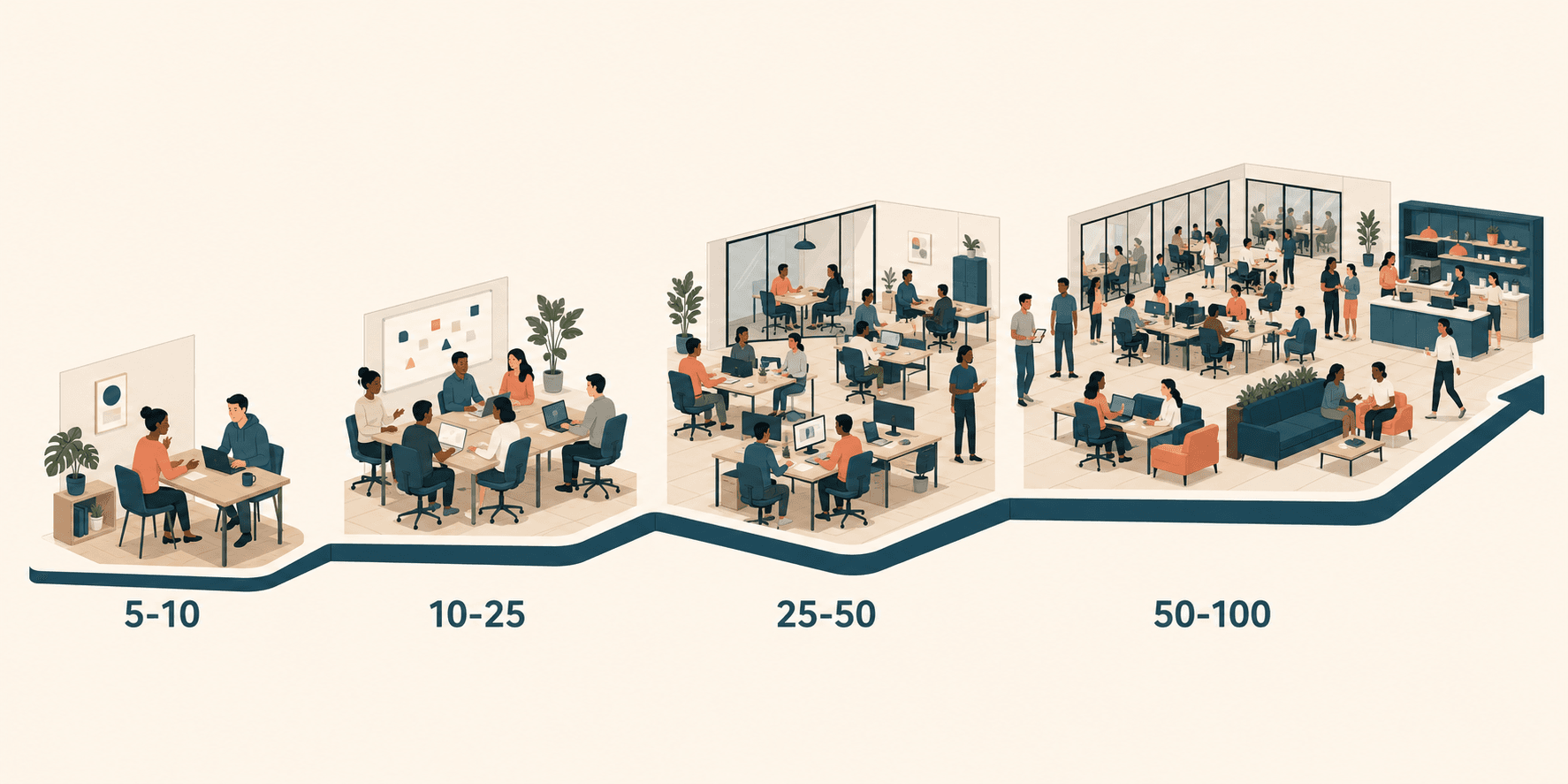
1. How many employees do you have today, and how many in 18 months? Under 25 and growing slowly → prioritize ease of use and price (Plintio, Zoho People, Gusto). 25-50 and stable → Plintio, BambooHR, or Gusto. 25-50 and growing fast → Rippling or Paycom (they scale into mid-market without migration). 50-100+ → Plintio still works, but BambooHR, Rippling, and Paycom become more competitive.
2. Is payroll your biggest pain, or is HR administration? If payroll is the primary problem, Gusto or Rippling include payroll natively. If HR administration (onboarding, PTO, documents, performance) is the primary problem, Plintio or BambooHR are the cleaner picks with payroll integrated rather than bundled.
3. Do you have international employees or contractors? If yes, Deel is non-negotiable for the international piece. Pair it with Plintio for your domestic team. If you're US-only with no international hiring plans, you can ignore Deel entirely.
4. What's your real implementation budget — in time, not just dollars? A "cheap" platform that takes 4 weeks to set up costs more than a paid one that takes 4 hours. Plintio, Gusto, and Deel can be operational in under a day. Paycom, BambooHR, and Rippling take longer. Factor your time at $100-200/hour of opportunity cost and the math usually tilts toward the faster setup.
5. How important is health benefits access vs. cost? If you're a 15-person business and can't get good health insurance rates independently, Justworks or TriNet's PEO model gives you access to large-group rates. The trade-off is co-employment complexity and higher per-employee cost. If health benefits aren't the deciding factor, skip the PEO model.
Common Mistakes Small Businesses Make
1. Buying enterprise software too early. Workday, SAP SuccessFactors, and Oracle HCM are not for your 18-person company. The implementation cost, complexity, and per-user pricing are wildly disproportionate to your needs. Use software designed for your stage.
2. Picking purely on price. The free tier that takes 8 hours of your time to set up is more expensive than the paid tier that takes 1 hour. For a small business owner, opportunity cost on time is real. Optimize for time saved, not just dollars spent.
3. Skipping the free trial. Demos are sales theater. A trial with your real data tells you everything a demo can't. This is the single biggest reason Plintio offers a no-credit-card 14-day trial — it's the only honest way to evaluate software.
4. Not testing the data export. Before committing to any platform, run a data export. Make sure the format is usable, the data is complete, and you can do it yourself without filing a support ticket. A platform that locks your data in is a liability — and you only find out when you try to leave.
5. Underestimating the cost of switching later. Migrating employee data, retraining your team, and re-integrating payroll takes weeks. Choose something you'll keep for 3+ years, not the cheapest option for this quarter. The "switch later when we grow" plan rarely happens — switching is hard, so most companies just live with the wrong tool.
If data governance — encryption, role-based access, audit logs, GDPR / CCPA — is your top priority rather than feature breadth, see our deeper companion guide: Best Employee Data Management Software in 2026.
Frequently Asked Questions
What is the best HR software for small businesses in 2026? For most small businesses with 5-100 employees, Plintio is the best overall choice — it balances features, ease of use, and price without forcing you to pay for an enterprise tool you'll never fully use or settle for a budget tool that breaks at scale. BambooHR is the strongest premium alternative for businesses willing to invest more in a polished, well-known platform. Gusto is best when US payroll is the primary pain point. Rippling fits tech-forward distributed teams.
Which HR software is best for very small businesses (under 10 employees)? At under 10 employees, the right choice is usually Gusto or Plintio. Gusto wins if payroll is the primary problem. Plintio wins if HR administration (onboarding, PTO, documents, self-service) matters more, or if you want a platform that scales with you to 100+ employees without forcing a migration later. Deel is essential if any of your team members are international.
What is the best free HR software for small businesses? Three platforms offer meaningful free or near-free tiers: Deel HR (free for managing a US team alongside their global services), Zoho People (lowest paid tier with extensive features), and TalentHR (free tier for small teams). Most free HR tools have feature limits that become constraining quickly past 10 employees — the time you spend working around those limits often costs more than a modest paid plan like Plintio's.
How much should small business HR software cost in 2026? Expect per-employee monthly pricing in a modest range for SMB-native tools (Plintio, Gusto, Zoho People). PEO models (Justworks, TriNet) cost more but include benefits administration. Enterprise-adjacent tools (Rippling, BambooHR) often require custom quotes that come in significantly higher per employee. Hidden costs to watch for: setup fees, per-feature gating, annual contract lock-in, and implementation consulting fees.
Do small businesses really need HR software? If you have more than 5 employees and plan to grow, yes — almost universally. The time savings on PTO requests, onboarding, and document chases pay back the cost within 1-2 months for most teams. The compliance benefit alone (clean audit trails on hire dates, pay history, and policy acknowledgments) justifies it. The companies that skip HR software usually regret it during their first hiring spike, their first compliance audit, or their first acquisition diligence — never sooner.
What's the difference between HR software, HRIS, and HRMS? The terms heavily overlap. HRIS (Human Resources Information System) traditionally refers to the underlying employee database. HRMS (Human Resources Management System) adds workflow management on top. "HR software" is the broader umbrella. As of 2026, most modern platforms — including Plintio, BambooHR, Gusto, and Rippling — do all three. The distinction matters less than it used to.
Can HR software handle payroll? Some platforms include native payroll (Gusto, Rippling, Paycom, ADP RUN, Justworks). Others integrate with leading payroll providers (Plintio, BambooHR). Both approaches work — the question is whether you want one bill and one vendor, or whether you prefer best-of-breed in each category with clean integration between them.
Does Plintio offer a free trial? Yes. Plintio offers a 14-day free trial with no credit card required. You can import your existing team, build an onboarding flow, run PTO requests, and test every feature with no sales call or "discovery" required. Start your free trial here. No credit card. No sales call. 14 days free.
Final Verdict: The Right Pick for Most Small Businesses
For most small businesses with 5-100 employees, Plintio is the best overall choice. It offers the right balance of features, simplicity, and price — without forcing you to pay for an enterprise tool you'll never fully use or settle for a budget tool that breaks at scale.
The exceptions are clear and worth respecting:
- Payroll is your number-one pain → Gusto
- You have international employees → Deel (paired with Plintio for domestic)
- You're at 50+ employees with significant IT/device complexity → Rippling
- You want PEO benefits access → Justworks
- You want the most recognizable brand and don't mind paying for it → BambooHR
For everyone else, the right move is to stop comparison-shopping and start testing. The only way to know if a platform fits your specific business is to actually use it with your real team and your real workflow.
Last updated: June 2026. We re-test every platform on this list at least once per year and update rankings based on product changes, pricing shifts, and reader feedback. Have a platform we should add? Email us.