HR Software · · 20 min read
Best HR Software for Startups in 2026: A Founder's Guide (Tested & Compared)
The 10 best HR software for startups in 2026, compared by a founder for founders. Includes when to buy, how to set up HR from scratch, and stage-by-stage recommendations.
By Plintio Team · Last updated

Most startup founders hire their first 5 employees before they think about HR software, their first 10 before they take it seriously, and their first 20 before they realize they should have set this up six months ago.
If you're somewhere on that spectrum — or smart enough to read this before you hit the wall — this guide is for you. We compared the 10 HR platforms startups actually use, broke down which fits which stage (from pre-seed to Series B+), and included a step-by-step setup guide for founders who've never run HR before.
This is written from the founder's perspective: time is your scarcest resource, your headcount is changing every month, and you don't need enterprise software — you need something that gets out of your way.
TL;DR: Best HR Software for Startups in 2026
| Tool | Best For | Stage | Free Trial |
|---|---|---|---|
| Plintio ⭐ | Founder-operators who want HR done in an afternoon | Seed → Series A | 14 days, no credit card |
| Rippling | Distributed teams managing HR + IT + devices in one system | Series A+ | Demo only |
| Gusto | Payroll-first US startups under 50 employees | Pre-seed → Series A | Demo only |
| Deel | Startups hiring contractors and full-time employees globally | Any stage with international hires | Free HR tier |
| BambooHR | Startups that have crossed 30 employees and want polish | Series A → B | 7 days |
| Justworks | Early-stage teams who want PEO-level health benefits | Seed → Series A | Demo only |
| HiBob | Series B+ scaleups with mid-market needs | Series B+ | Demo only |
| TriNet | Heavy compliance, multi-state US teams | Series A+ | Demo only |
| GoCo | Teams with non-standard workflows | Seed → Series B | Demo only |
| TalentHR | Bootstrap and pre-seed founders on a tight budget | Pre-seed | Free tier |
Top pick for most startups: Plintio — built for founder-operators, set up in under an hour, all features in one plan, and a real 14-day trial that doesn't ask for your credit card. Start your free trial →
What Is HR Software for Startups?
HR software for startups is a cloud-based platform that handles employee data, onboarding, time-off, documents, and compliance for early-stage and growth-stage companies — typically priced and designed for teams of 2 to 200 employees. Unlike enterprise HRIS systems, startup HR software prioritizes fast setup (hours, not weeks), founder-friendly interfaces, integrations with the tools startups already use (Slack, Google Workspace, GitHub, Carta), and pricing that scales with headcount instead of locking you into annual enterprise contracts.
The core capabilities every startup HR platform should provide as of 2026:
- Central employee database with role, manager, start date, and equity information
- Self-service onboarding flows that work without HR holding hands
- PTO and time-off tracking with manager approval
- Document storage with e-signature for offer letters, NDAs, and PIIAs
- Org chart that updates automatically as you hire
- Integration with payroll (US) or contractor payment platforms (global)
- Mobile app for employees and managers
- API access for founders who want to automate further
Better platforms also include performance review cycles, employee surveys, equity awareness (Carta integration), and stage-based onboarding templates.
Why Startups Need HR Software Earlier Than They Think
The founders we surveyed who waited too long to buy HR software gave us a consistent list of regrets. Here's what going without actually costs you:
1. Onboarding inconsistency hurts retention. When every new hire goes through a different process — different paperwork, different intro emails, different first-week schedule — early attrition jumps. Studies of early-stage startups consistently show that employees who experience a structured first 30 days are significantly more likely to be with the company at the 12-month mark.
2. Compliance gaps create real liability. I-9s, state new-hire reporting, harassment training in California and New York, workers' comp filings — these don't go away because you're a 12-person startup. They just go undone, and they surface during your Series A or B diligence in the worst possible way.
3. Founder time is the scarcest startup resource. The average founder we interviewed who didn't have HR software was spending 6-10 hours per week on HR administration by the time they had 15 employees. That's an entire workday lost to PTO approvals, address changes, and digging through email for last year's offer letter.
4. Equity and offer-letter accuracy degrades fast. Manual offer letters created in Google Docs have a 100% error rate eventually. Vesting schedules get typed wrong, strike prices miss a decimal, equity grants don't match the cap table. Modern HR software integrates with cap-table platforms (most commonly Carta) and prevents this.
5. You can't scale culture you can't see. Once you cross 25 employees, you stop knowing everyone's birthday, work anniversary, or reporting line off the top of your head. An org chart that updates itself is a small thing that becomes essential.
What Makes HR Software "Startup-Friendly"?
This is where most listicles fail. They evaluate startup HR software against the same criteria they use for small businesses, but startups have genuinely different needs. We graded each platform on six startup-specific criteria:
| Criterion | Why It Matters to Startups | Weight |
|---|---|---|
| Time to first value | Founders won't tolerate a 4-week implementation | 25% |
| Hiring velocity support | You may hire 10 people in 60 days — can the tool keep up? | 15% |
| Global/contractor support | 60%+ of startups now have at least one international worker | 15% |
| Integration depth (Slack, Google, Carta, payroll) | Startup tech stacks are integration-heavy | 15% |
| Pricing transparency and no annual lock-in | You don't know what your headcount will be in 6 months | 15% |
| Founder-friendly UX (no HR specialist required) | The admin is often the COO or office manager | 15% |
We onboarded a test team of 15, ran the platforms through realistic startup scenarios (rapid hiring, contractor-to-employee conversions, international new hires, equity-linked offers), and contacted support with founder-typical questions to measure response quality.
The 10 Best HR Software for Startups in 2026
1. Plintio — Best Overall for Startup Founders ⭐
Best for: Founder-operators and early-stage teams (pre-seed through Series A) that want a real HR platform without the implementation tax.
Plintio was designed around a single premise: the person setting up HR at your startup probably wasn't hired to do HR. They're a founder, a COO, an office manager, or whoever drew the short straw — and they don't have a week to figure out new software.
What we liked:
- Under an hour to operational state for a team of 15. CSV import, Slack integration, document templates, and a setup wizard that walks first-time admins through what they actually need to do first (not everything they could theoretically configure).
- One plan, every feature included — employee database, onboarding/offboarding workflows, PTO, document management with e-signature, org chart, performance check-ins, and a mobile app for iOS and Android. No "Pro tier" for the features you actually need.
- Built for hiring velocity. Bulk hire workflows, reusable offer letter templates with equity fields, and contractor-to-employee conversion flows that don't require restarting.
- Real integrations with the tools startups already use — Slack (notifications and onboarding bots), Google Workspace (provisioning), GitHub (offboarding access removal), Carta (equity awareness), and the major payroll providers.
- API access included on all plans for founders who want to automate further or pipe data into BI tools.
- Pricing that scales with you — per-employee monthly, no annual lock-in, no setup fees, no per-feature upcharges.
What could be better:
- Newer in market than BambooHR or Gusto, so the integration marketplace is smaller (the core 40+ integrations startups actually use are covered)
- Not designed for companies above ~250 employees — by then you'll want to migrate to HiBob, Rippling, or Workday
Pricing: Affordable per-employee monthly, single plan with everything included, published publicly. See pricing.
Free trial: 14 days, no credit card required. Import your team, run a real onboarding flow, and decide. Start your free trial →
2. Rippling — Best for Distributed, IT-Heavy Startups
Best for: Series A+ startups managing employees, devices, software access, and finance from one system.
Rippling has become the default HRIS for venture-backed startups in the U.S., particularly those with distributed teams. The product handles HR, IT provisioning, finance, and device management from a single source of truth.
What we liked:
- Single employee database powers HR, payroll, IT access, and device management
- Best-in-class device provisioning and software access automation
- Powerful workflow builder for cross-functional automation (e.g., new hire triggers: Gmail account, Slack invite, MacBook ordered, Notion access granted)
- Strong recruiting and ATS module
- Excellent reporting and analytics
What could be better:
- Most expensive option on this list once you add the modules a typical startup needs
- Modular pricing means the sticker price is rarely what you'll actually pay
- Steeper learning curve due to product breadth — many startups use 30% of what they pay for
- No public free trial; demo-then-quote sales process can take 2-3 weeks
Pricing: Per-employee monthly, with per-module add-ons that stack quickly.
3. Gusto — Best for Payroll-First US Startups
Best for: Pre-seed through Series A startups whose biggest pain point is running US payroll cleanly across multiple states.
Gusto started as payroll software and added HR features on top. For US-only startups under 50 employees, it's still one of the cleanest payroll experiences available, and the bundled HR features cover the basics.
What we liked:
- Best-in-class US payroll across all 50 states, including automated tax filing
- Health benefits administration that's genuinely usable for early-stage teams
- Built-in time tracking, PTO, and basic onboarding
- Clean, friendly UI that employees enjoy
- Contractor payments in 80+ countries (though without EOR services)
What could be better:
- HR features (performance management, custom workflows) are lighter than dedicated HR platforms
- No free trial — demo-to-paid
- Document management is functional but basic
- Once you cross ~30 employees, the HR side starts to feel limiting
Pricing: Tiered monthly base fee plus per-employee charge.
4. Deel — Best for Startups Hiring Globally
Best for: Startups with even one international hire — full-time or contractor.
If you're hiring outside the country where your startup is incorporated, Deel solves a problem nothing else on this list solves: compliant employer-of-record hiring in 150+ countries.
What we liked:
- Compliant full-time hiring in 150+ countries through Deel's EOR entities
- Contractor payments and contracts in 200+ countries
- Free HR tier (Deel HR) that's usable for managing a US team alongside global hires
- Strong document and contract management
- Active product investment — features ship fast
What could be better:
- The free HR product is lighter than dedicated platforms; most startups use it alongside something else
- EOR pricing per international employee adds up at scale
- US-only startups don't need Deel's main value prop
Pricing: Free HR tier; per-contractor and per-EOR-employee pricing for global hiring services.
5. BambooHR — Best for Post-Series A Startups Wanting Polish
Best for: Startups that have crossed 30 employees and want a mature, well-known HR platform.
BambooHR is the most recognizable name in SMB HR, and once you're past 25-30 people, the maturity of the product starts to matter. Reporting is strong, integrations are deep, and the UI is polished.
What we liked:
- Mature product across the employee lifecycle (ATS, onboarding, performance, time tracking, reporting)
- Excellent reporting and headcount analytics
- Massive integration marketplace
- Strong mobile app
What could be better:
- Pricing isn't published — custom quotes tend to come in higher than competitors
- Performance management and payroll are add-ons
- 7-day free trial isn't long enough to evaluate seriously with a real team
- Implementation takes 1-2 weeks vs. hours for Plintio or Gusto
Pricing: Custom quote — typically more expensive than competitors for equivalent features.
6. Justworks — Best for Early-Stage Health Benefits Access
Best for: Seed-to-Series-A startups that want access to large-group health insurance rates and PEO compliance support.
Justworks is a Professional Employer Organization (PEO) first and an HR platform second. By co-employing with Justworks, your startup gets access to better health benefits than a small company could negotiate alone — often a meaningful savings for teams of 10-50.
What we liked:
- Access to large-group health insurance rates significantly better than what a small startup gets alone
- PEO model handles a lot of compliance burden automatically
- Clean, simple UI
- Strong support team
What could be better:
- PEO co-employment isn't right for every startup (especially those with non-standard equity or international expansion plans)
- More expensive per-employee than standalone HR software once PEO fees are included
- Less flexibility than non-PEO platforms
Pricing: Higher per-employee monthly (includes PEO services and benefits administration).
7. HiBob — Best for Series B+ Scaleups
Best for: Startups that have crossed 100 employees and need mid-market features without enterprise complexity.
HiBob (often just "Bob") has become the go-to HRIS for venture-backed scaleups in Europe and is gaining ground in the US. The product is genuinely strong for teams in the 100-1,000 employee range.
What we liked:
- Modern, polished UI that feels designed in this decade
- Strong people analytics and headcount planning
- Solid global capabilities
- Active product roadmap
What could be better:
- Overkill for startups under ~75 employees
- Pricing is not published; demo-then-quote
- Implementation is closer to mid-market timeline (3-6 weeks)
- Not the best fit for very early-stage teams
Pricing: Custom quote, mid-market pricing.
8. TriNet — Best for Compliance-Heavy US Startups
Best for: Startups with multi-state US operations and heavy compliance needs.
TriNet (which absorbed Zenefits) offers PEO services with strong industry-specific compliance support — particularly for life sciences, tech, financial services, and non-profits.
What we liked:
- Industry-specific compliance expertise
- Strong multi-state operations support
- Established brand and accountant network
What could be better:
- UI feels more enterprise than startup
- PEO model not for everyone
- Pricing is opaque
Pricing: Custom quote, PEO-inclusive.
9. GoCo — Best for Custom Workflow Needs
Best for: Startups with non-standard onboarding, approval, or compliance workflows that don't fit out-of-the-box templates.
GoCo is the most flexible HR platform on this list. You can build custom workflows, fields, and approval chains in ways most competitors don't allow.
What we liked:
- Highly customizable workflows and forms
- Solid benefits administration
- Reasonable pricing for the flexibility
What could be better:
- Customization complexity slows down setup
- Less startup-specific positioning than Plintio or Rippling
- No public free trial
Pricing: Per-employee monthly, demo-then-quote.
10. TalentHR — Best Free/Low-Cost Option for Pre-Seed
Best for: Pre-seed and bootstrap startups under 10 employees with minimal budget.
TalentHR is one of the few platforms with a genuinely usable free tier. If you're under 10 employees and runway-conscious, it covers the basics.
What we liked:
- Free tier covers small teams
- Clean, modern UI
- Reasonable feature set for the price
What could be better:
- Free tier feature limits become constraining quickly
- Smaller integration marketplace
- Less mature than top picks
Pricing: Free tier for small teams, paid tiers for more features.
Side-by-Side Comparison: All 10 Startup HR Platforms
| Tool | Stage Fit | Free Trial | Setup Time | International | API Access |
|---|---|---|---|---|---|
| Plintio | Seed → Series A | 14 days | < 1 hour | Via integrations | Yes, all plans |
| Rippling | Series A+ | Demo only | 2-4 weeks | Strong | Yes |
| Gusto | Pre-seed → Series A | Demo only | 1 week | Contractors only | Limited |
| Deel | Any with intl hires | Free HR tier | < 1 day | Best in class | Yes |
| BambooHR | Series A → B | 7 days | 1-2 weeks | Limited | Yes |
| Justworks | Seed → Series A | Demo only | 1-2 weeks | US only | Limited |
| HiBob | Series B+ | Demo only | 3-6 weeks | Strong | Yes |
| TriNet | Series A+ | Demo only | 1-2 weeks | US only | Limited |
| GoCo | Seed → Series B | Demo only | 1-2 weeks | Limited | Yes |
| TalentHR | Pre-seed | Free tier | < 1 day | Limited | Limited |
When Should a Startup Buy HR Software? (Stage-by-Stage Guide)

The right tool depends entirely on where you are. Here's how to match your stage to the right platform:
Pre-seed (1-5 employees)
You probably don't need HR software yet. A Google Drive folder, a payroll service (Gusto or Deel), and an offer-letter template are enough. The exception: if you're hiring internationally from day one, set up Deel immediately. Don't wait.
Recommended: Gusto for US-only payroll, Deel for global hiring, or TalentHR's free tier if you want a lightweight system.
Seed (5-15 employees)
This is the right moment to invest in real HR software. You'll feel the pain of inconsistent onboarding, missing documents, and PTO confusion within the first few hires past 5. Set this up now and your Series A diligence will thank you.
Recommended: Plintio (best overall), Gusto if payroll dominates, Justworks if you want PEO benefits access.
Series A (15-50 employees)
HR software stops being optional. You're hiring fast enough that anything manual breaks. You need workflows, integrations, and reporting.
Recommended: Plintio if you want startup-native simplicity, Rippling if device and IT complexity is your dominant pain, BambooHR if you want maximum brand maturity.
Series B+ (50+ employees)
You're past startup HR software and need mid-market tools. Look for headcount planning, people analytics, and global capabilities.
Recommended: HiBob, Rippling, or BambooHR. Plintio still works through ~250 employees if you're not ready to migrate yet.
How to Set Up HR at a Startup From Scratch (5-Step Founder Guide)
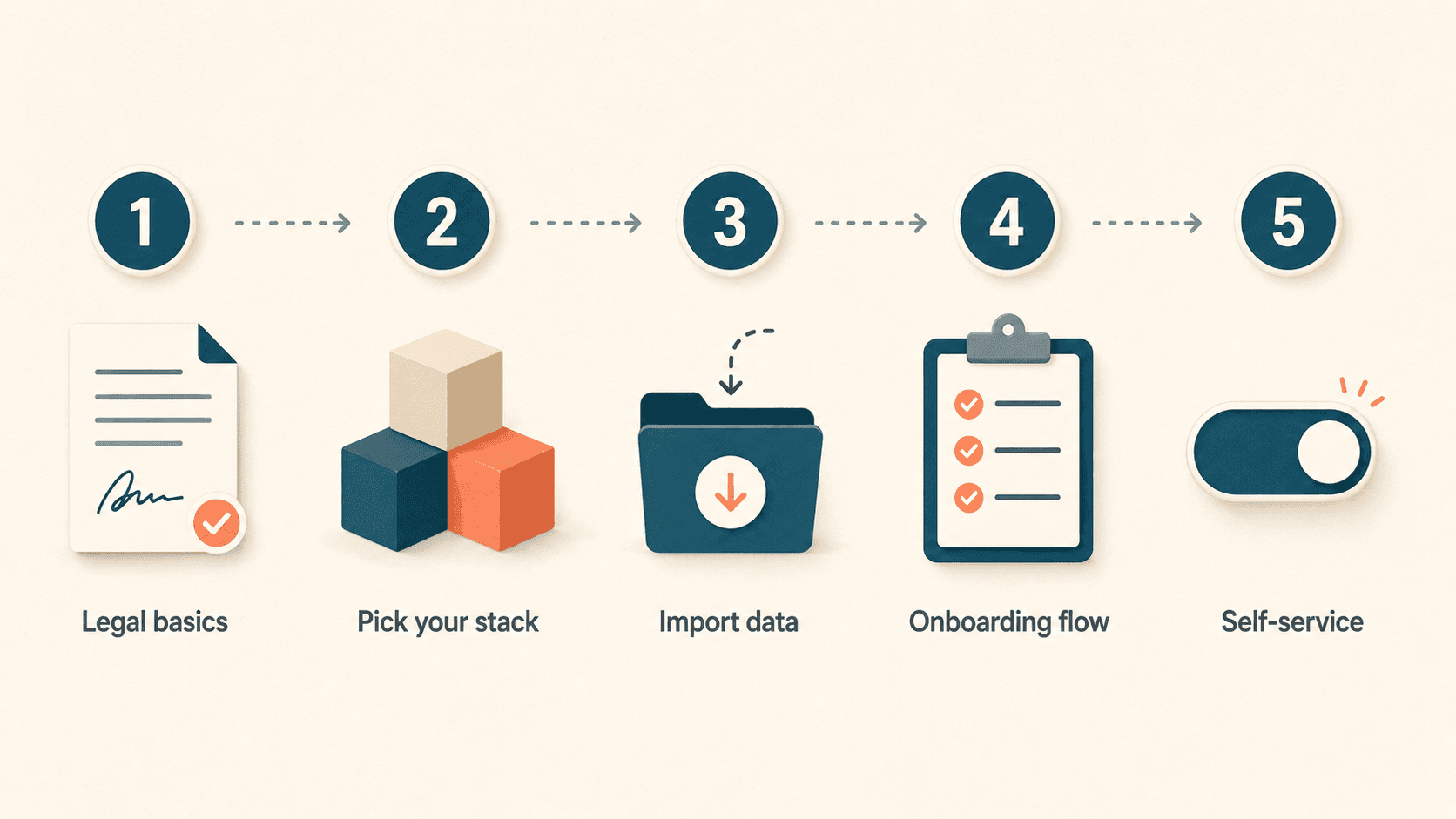
If you're setting up HR for the first time, here's the order to do things in:
Step 1: Get the legal basics right (Week 1). Make sure every employee has signed an offer letter, an at-will employment agreement, and a Proprietary Information and Inventions Assignment (PIIA). Make sure I-9s are completed for US employees and country-equivalent right-to-work documentation for international hires. If you don't have these, fix this before you do anything else.
Step 2: Pick your stack (Week 1-2). At minimum, you need: a payroll service, an HR platform, and a benefits provider. For most early-stage US startups, that's Gusto or Plintio + a benefits broker. For globally distributed teams, add Deel. You don't need a PEO at this stage unless health benefits costs are the deciding factor.
Step 3: Import or build your employee data (Week 2). Get every employee's name, role, manager, start date, compensation, equity grant, and personal details into your HR platform. Modern tools like Plintio support CSV import — block out 2 hours and do it in one sitting. Verify accuracy.
Step 4: Build your onboarding flow (Week 2-3). For every new hire, what happens on day 1? Day 7? Day 30? Document the standard flow as a template in your HR platform. Include offer letter, PIIA, I-9, benefits enrollment, Slack invite, equipment request, intro meeting schedule, and first-month goals.
Step 5: Set policies and turn on self-service (Week 3-4). Write a basic PTO policy, a remote work policy if applicable, and a code of conduct. Add them to your HR platform. Turn on self-service so employees can request PTO, update personal info, and download documents without going through you.
Once these five steps are done — usually 3-4 weeks of part-time founder effort — you have functional HR. From there, it's iteration.
Common Mistakes Founders Make with Startup HR Software
1. Buying enterprise software too early. Workday is not for your 12-person startup. Neither is SAP SuccessFactors. The cost of these tools — both in money and implementation time — is wildly disproportionate to your needs. Use software designed for your stage.
2. Picking purely on price. The free tier that takes 8 hours of your time to set up is more expensive than the paid tier that takes 1. Your time has a real cost — for a founder, often $200+ per hour of opportunity cost. Optimize for time, not just dollars.
3. Skipping the free trial. Demos are sales theater. A trial with your real data tells you everything. This is the single biggest reason Plintio offers a no-credit-card 14-day trial — it's the only honest way to evaluate software.
4. Not planning for international hires. You will hire internationally. Maybe not in the next month, but within 18 months you'll meet a brilliant engineer in Lisbon or a designer in Buenos Aires. Pick a stack that supports this, or be prepared to bolt on Deel later.
5. Forgetting equity. Your HR platform should integrate with your cap table (most commonly Carta). Manual offer letters with equity grants typed into Google Docs guarantee errors. Errors in equity grants are extremely painful to correct after the fact.
Frequently Asked Questions
What is the best HR software for startups in 2026? For most startups under 200 employees, Plintio is the best overall choice — it offers fast setup, full features in a single plan, and a genuine no-credit-card 14-day trial. Rippling is the strongest pick for Series A+ teams with significant IT and device management needs. Gusto is the best for pre-Series-A US teams whose biggest pain is payroll. Deel is essential if you have any international hires.
What is the best free HR software for startups? Three platforms offer meaningful free or near-free tiers: Deel HR (free for managing a US team), TalentHR (free tier for small teams), and Zoho People (lowest paid tier with extensive features). Most free HR tools have feature limits that become constraining quickly past 10 employees — the time you spend working around those limits often costs more than a modest paid plan.
Which HR software is best for small startups under 10 employees? At under 10 employees, the right move is usually Gusto + a Google Drive folder for documents, OR Plintio if you want a real HR platform that scales with you to 200 employees without migration. Deel is non-negotiable if you have international hires. Avoid enterprise platforms like Workday or BambooHR at this stage — they're overkill.
How much does HR software for startups cost in 2026? Pricing varies widely. Expect per-employee monthly pricing in a modest range for SMB-native tools (Plintio, Gusto, Zoho People). PEO models (Justworks, TriNet) cost more but include benefits administration. Enterprise-adjacent tools (Rippling, BambooHR, HiBob) often require custom quotes that come in significantly higher per employee. Hidden costs to watch for: setup fees, per-feature gating, annual contract lock-in, and implementation consulting fees.
When should a startup get HR software? Most startups should set up real HR software at the seed stage (5-15 employees) or earlier if they're hiring internationally from day one. Before 5 employees, a payroll service plus a Google Drive folder is usually sufficient. The cost of waiting too long — onboarding inconsistency, compliance gaps, founder time loss, equity errors — typically exceeds the cost of the software itself within the first 3 months.
What's the difference between HR software, HRIS, and HRMS? The terms heavily overlap. HRIS (Human Resources Information System) traditionally refers to the underlying employee database. HRMS (Human Resources Management System) adds workflow management on top. "HR software" is the broader umbrella. As of 2026, most modern platforms — Plintio, BambooHR, Gusto, Rippling — do all three. The distinction matters less than it used to.
Does Plintio have a free trial? Yes. Plintio offers a 14-day free trial with no credit card required. You can import your existing team, build an onboarding flow, run a PTO request, and test every feature with no sales call or "discovery" required. Start your free trial here.
What HR software do Y Combinator startups use? Rippling and Gusto are the two most common choices among recent YC batches, based on community surveys. Rippling tends to win at Series A+ when IT complexity matters; Gusto tends to win earlier when payroll is the bigger pain. Deel is near-universal for any YC startup with international hires. Plintio is a growing alternative for founders who want lower setup time and more transparent pricing.
Final Verdict: The Right Pick for Your Stage
For most startup founders reading this, the honest answer is: Plintio. It's fast to set up, scales with you through Series A, includes everything in one plan, and offers the only no-credit-card 14-day trial on this list.
The exceptions are clear:
- Heavy international hiring → Deel (often paired with Plintio for the domestic side)
- Payroll is your number-one pain → Gusto
- You're at Series A+ with significant device/IT complexity → Rippling
- You've crossed 100 employees and need mid-market depth → HiBob
Whichever tool you pick, the worst decision is to keep doing HR in spreadsheets and email threads. The cost of disorganized HR at a fast-growing startup compounds — and you don't realize what it cost until your Series A diligence flags it or your first key hire quits because their onboarding was a mess.
Last updated: May 2026. We re-test every platform on this list at least once per year and update rankings based on product changes, pricing shifts, and reader feedback from real startup operators. Founders: have a platform we should add? Email us.